Dubai vs Abu Dhabi property investment is the first comparison most UAE investors make, and it rarely produces a universal winner. Dubai is the larger, deeper, more international market. Abu Dhabi is smaller, but its sales and rents are growing faster. Which market suits you depends on budget, location, property type, investment horizon, rental strategy, and tolerance for risk. The two markets sit at different points in the cycle: Dubai is moderating after five years of exceptional growth, while Abu Dhabi is expanding quickly, mostly through off-plan sales. A fair comparison uses equivalent periods and definitions and then judges the individual property, so this guide uses H1 2026 data for both emirates wherever it exists, and each figure carries its period and source.
Key takeaways
- Dubai is the bigger, more liquid market: AED 286.44 billion of property sales in H1 2026 alone, with the median apartment price per sq ft down 2% year on year as the market matures.
- Abu Dhabi is smaller but growing faster: AED 117 billion of transactions in H1 2026 (+112%), repeat-sale apartment prices up 20%, but 89% of residential sales value is off-plan.
- Rental yields have no official like-for-like citywide figure; calculate net yield per property (see the worked example below).
- In both emirates, foreigners can buy in designated areas, and a property investment of at least AED 2 million can support a UAE Golden Visa application.
- Choose Dubai for liquidity, ready stock and resale depth;choose Abu Dhabi for earlier-cycle growth if you accept off-plan timing and the 2028 supply peak.
Table of Contents
- Dubai vs Abu Dhabi Property Investment: Market Comparison
- Why Investors Consider Dubai Property
- Why Investors Consider Abu Dhabi Property
- Comparable Areas in Dubai and Abu Dhabi
- Dubai vs Abu Dhabi Rental Yields: What Should Investors Compare?
- Off-Plan vs Ready Property in Dubai and Abu Dhabi
- Foreign Ownership Rules in Dubai vs Abu Dhabi
- Golden Visa, Mortgages and Tax: Rules ThatApplyin Both Emirates
- Property Investment Costs and Risks to Consider
- Which Market Is Better for Your Investment Goals?
- How Blueline Properties Helps You Compare Dubai and Abu Dhabi
- Final Verdict
- Frequently Asked Questions
Dubai vs Abu Dhabi Property Investment: Market Comparison
Start with the periods, because headline figures are easy to misread. Both columns use first-half (H1) 2026 data, January to June, wherever official or registered data exists; where a figure covers another period, that period is stated. Investors comparing Dubai vs Abu Dhabi property prices should treat the table as a map of scale and direction, not a scoreboard.
| Comparison point | Dubai | Abu Dhabi |
| Market activity and transaction trends | Total transactions: AED 419.9 billion in H1 2026, including AED 286.44 billion of sales across about 86,000 deals (Dubai Land Department data) | Total transactions: AED 117 billion in H1 2026 (+112% value, +61.7% volume) (ADREC) |
| Sales mix | H1 2026 sales split: ready AED 146.7 billion (about 27,200 deals) and off-plan AED 139.8 billion (about 58,800 deals) (DLD data) | Residential unit sales AED 70.4 billion in H1 2026; off-plan 89% of sales value (ADREC) |
| Residential price trends | Median apartment price AED 1,730 per sq ft in H1 2026, down 2% year on year; prices moderating after five years of exceptional growth (DXBinteract registered sales; Cushman & Wakefield Core) | Repeat sales prices up 20% year on year for apartments and 12% for villas (ADREC, H1 2026) |
| Rental market indicators | Buyers and tenants hold more negotiating power than a year ago (Cushman & Wakefield Core) | 233,000 lease contracts; new-lease prices up 17% for apartments and 9% for villas (ADREC, H1 2026) |
| Current and projected supply | Large handover pipeline; performance varies by location and asset class | About 409,000 existing units; about 71,000 more by 2030, peaking in 2028 (ADREC) |
| Foreign ownership | Freehold ownership in designated freehold areas (UAE Government portal) | Ownership rights in designated investment zones; 50 zones (ADREC) |
| Investment risks to check | Local oversupply in specific districts; softer pricing in maturing segments | Heavy reliance on off-plan sales; delivery peak in 2028; thinner resale history in newer zones |
| Main purchase fee | 4% DLD transfer fee, listed as 2% buyer + 2% seller on Dubai Now, plus AED 250 title deed (DLD) | Registration fee commonly quoted at about 2%, often split between buyer and seller; confirm with ADREC |
| Golden Visa route | Property investment of AED 2 million or more (UAE Government portal) | Same federal AED 2 million threshold (UAE Government portal) |
Two patterns stand out. First, scale: in the same six months, Dubai recorded AED 286.44 billion of property sales alone, more than double Abu Dhabi’s AED 117 billion of total transactions. Second, cycle position. Dubai’s market is entering a more balanced phase, with buyers and tenants gaining negotiating power, according toCushman & Wakefield Core’s H1 2026 Dubai market update. Abu Dhabi’s growth is led by new leases and off-plan sales inside investment zones (source: ADREC’s H1 2026 real estate market report). Dubai vs Abu Dhabi real estate is not a contest between a rising and a falling market: it is a mature market cooling selectively against a smaller one heating up from a lower base.
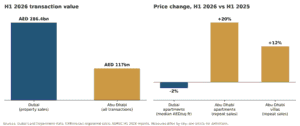
Chart: Dubai vs Abu Dhabi property market, H1 2026. Sources: Dubai Land Department data; DXBinteract; ADREC.
Why Investors Consider Dubai Property
Dubai’s main attraction is depth. No other UAE market matches its volume of buyers, tenants, developers, and resale activity. That depth supports liquidity: comparable sales, real rents, and a realistic exit route are all visible before buying.Dubai property investment 2026 is now a selection exercise inside one city, because performance varies sharply by district and property type. Blueline Properties’ property sourcing and shortlisting starts from that spread, narrowing the city to districts and buildings that fit an investor’s budget and rental strategy.
Activity remains high even as conditions soften: total transactions reached AED 252 billion in Q1 2026, up 31% in value year on year, with investment value of AED 173 billion across 57,744 investments (source:Dubai Land Department’s Q1 2026 transaction announcement). Foreign investors accounted for AED 148.35 billion of it. Over the full first half, sales reached AED 286.44 billion across about 86,000 deals, split almost evenly between ready (AED 146.7 billion) and off-plan (AED 139.8 billion) property, while the median apartment price eased to about AED 1,730 per sq ft, 2% below a year earlier (DLD data; DXBinteract registered sales).

The direction of travel matters more than the totals. After five years of exceptional growth, residential prices are moderating as the market matures, and buyers and tenants hold more negotiating power than a year earlier, according toCushman & Wakefield Core’s H1 2026 Dubai market update. Achievable rent and today’s price matter more than last year’s growth story. A large handover pipeline leaves some districts oversupplied while others stay tight. Dubai real estate market trends reward investors who price each unit on current evidence.
Why Investors Consider Abu Dhabi Property
Abu Dhabi’s market is smaller, regulated centrally by ADREC, and currently growing from a lower base. Residential unit sales reached AED 70.4 billion in H1 2026, against AED 25.3 billion in the same period of 2025 (source:ADREC’s H1 2026 real estate market report). Repeat sales prices rose 20% year on year for apartments and 12% for villas. It is a market earlier in its growth phase than Dubai.
The rental market is deep. ADREC recorded 233,000 residential lease contracts in H1 2026, with lease values of AED 9.3 billion, up 8% year on year. New-lease prices rose 17% for apartments and 9% for villas. New-lease growth is not growth across all existing rents, but it shows where asking levels move. Most investment activity sits in designated investment zones such as Al Reem Island, Yas Island and Saadiyat Island, where foreign buyers may own property. Blueline Properties advises investors across both emirates, so zone and developer checks like these sit inside the same comparison.
Two cautions accompany the growth. Off-plan properties accounted for 89% of residential sales value in H1 2026, so today’s market depends heavily on future delivery. Around 71,000 additional homes are projected by 2030, with deliveries peaking in 2028, against an existing stock of about 409,000 units. Foreign direct investment reached AED 13.8 billion in H1 2026, and eight new investment zones took the total to 50(source:ADREC’s H1 2026 transaction report). Abu Dhabi real estate market trends favour investors who check the zone, the developer, and the delivery year;Abu Dhabi property investment 2026 rewards that discipline, not headline growth.
Comparable Areas in Dubai and Abu Dhabi
City averages hide the real decision, which is usually between two specific districts. The pairings below match Dubai areas with Abu Dhabi investment zones that attract a similar buyer and tenant profile. Dubai figures are for apartments in 2026 to date, from DLD-registered transactions compiled by DXBinteract; Abu Dhabi does not yet publish equivalent official area-level data, so compare project-level ADREC data and achieved rents for each shortlisted unit.
| Investor profile | Dubai area (apartments, 2026) | Abu Dhabi counterpart | What to check |
| Waterfront living, deep tenant demand | Dubai Marina: median price AED 1.9 million, AED 1,990 per sq ft, gross yield about 7% | Al Reem Island | Service charges and the number of new towers handing over nearby |
| Prime and trophy assets | Downtown Dubai: median price AED 3.0 million, AED 2,980 per sq ft, gross yield about 6% | Saadiyat Island | Lower yields; returns lean on capital growth and resale depth |
| Mid-market, yield-focused | Jumeirah Village Circle (JVC): median price AED 1.0 million, AED 1,470 per sq ft, gross yield about 8% | Al Reef and Masdar City | Handover pipeline, vacancy, and how quickly comparable units resell |
Source for Dubai figures: DXBinteract location statistics (DLD-registered sales and rent contracts), accessed November 2026. Gross yields are before costs.
Want this comparison run on real units? Blueline’s advisors can build a side-by-side shortlist of Dubai and Abu Dhabi properties with achieved rents, service charges, and net yields. Request your Dubai vs Abu Dhabi shortlist.
Dubai vs Abu Dhabi Rental Yields: What Should Investors Compare?
The honest answer on Dubai vs Abu Dhabi rental yields is that no official or original research source publishes a like-for-like citywide yield for both markets. Portal and agency tables use listing prices and different methods, so a single “Dubai pays X, Abu Dhabi pays Y” line would mislead.
Compare the calculation instead. Gross rental yield = annual rental income ÷ purchase price × 100. Net rental yield = annual rental income after operating costs ÷ total investment cost × 100. Costs include service charges, maintenance, management fees, vacancy, and purchase transaction expenses.
Worked example: net yield on an AED 1.5 million apartment
The figures below are illustrative, not a quote, but they show why gross and net yields differ.
| Item | Amount (AED) |
| Purchase price | 1,500,000 |
| Purchase costs (transfer or registration fees, agency and admin fees; assumed 6%) | 90,000 |
| Total investment | 1,590,000 |
| Annual rent achieved | 100,000 |
| Service charges (1,000 sq ft at AED 18 per sq ft) | -18,000 |
| Management and maintenance (5% of rent) | -5,000 |
| Vacancy (one month a year) | -8,333 |
| Net annual income | 68,667 |
| Gross yield (100,000 / 1,500,000) | 6.7% |
| Net yield (68,667 / 1,590,000) | 4.3% |
The same unit loses more than two percentage points between the gross and net figures. For context, registered data shows median apartment gross yields of about 7% in Dubai Marina, 6% in Downtown Dubai, and 8% in JVC in 2026 (DXBinteract). Run the same calculation in Abu Dhabi using the zone’s actual service charges and its lower registration fee before comparing the two.
Then compare properties, not cities. Two apartments in the same Dubai district can produce different net yields through service charges alone; the same applies across Abu Dhabi’s zones. Abu Dhabi’s rising new-lease prices and Dubai’s stronger tenant negotiating power describe rental direction in each market, not yield. Our guides toDubai real estate investment ROI andAbu Dhabi property investment work through zone-level returns. What decides rental income from UAE property is the rent actually achieved, the price paid, and the building’s charges.
Off-Plan vs Ready Property in Dubai and Abu Dhabi
Off-plan vs ready property in the UAE is a choice about timing and risk, and works the same way in both. Off-plan buyers pay in stages during construction and receive no rent until handover. They carry completion and contract risk, plus the risk that many similar units finish at once. Abu Dhabi’s 89% off-plan share of residential sales value and its 2028 delivery peak make that supply question concrete (source:ADREC’s H1 2026 real estate market report).
Ready property can be inspected, its service charges and achieved rents are visible, and rental income can start sooner, subject to finding a tenant. The trade-off is a larger upfront outlay, paid in full today. Resale also differs: selling a ready home is a standard transaction, while selling off-plan before handover usually needs the developer’s approval. Neither route is automatically safer or more profitable. Our detailed comparison ofoff-plan vs ready property in Dubai covers worked examples; the same tests apply in Abu Dhabi: developer record, escrow and registration, payment schedule, and exit options.
Foreign Ownership Rules in Dubai vs Abu Dhabi
UAE property investment for foreigners is allowed in both emirates, but only inside designated areas, and the structures differ. In Dubai, foreigners may acquire freehold ownership in designated freehold areas, or usufruct and leasehold rights up to 99 years, with title deeds issued by the Land Department, according to the UAE Government portal’s guidance for expatriates buying property.
In Abu Dhabi, non-UAE nationals may own property within designated investment areas. The same official guidance lists areas including Yas Island, Saadiyat Island, Al Reem Island, Al Maryah Island, Al Raha Beach, Al Reef and Masdar City, and the ownership systems include 99-year ownership of residential units, musataha and usufruct rights. ADREC expanded the investment zones to 50 in H1 2026 (source:ADREC’s H1 2026 transaction report). Eligibility attaches to the zone and the specific property, so verify both with the relevant authority before paying a deposit.
Golden Visa, Mortgages and Tax: Rules That Apply in Both Emirates
Golden Visa. Property investors can apply for a UAE Golden Visa with a minimum investment of AED 2 million, according to the UAE Government portal’s Golden Visa page. The rule is federal, so a qualifying property in Dubai or Abu Dhabi counts the same way. Conditions for mortgaged and off-plan property, and the visa term, are set by the issuing authorities and change over time, so confirm eligibility for the specific unit before you rely on it.
Mortgages. Banks in both emirates lend to UAE residents and to many non-residents, but loan-to-value limits, income requirements, and off-plan lending rules are set by the UAE Central Bank and each lender. Non-residents should expect a larger deposit than residents, so get mortgage pre-approval before reserving a unit.
Tax. The UAE has no annual property tax and no personal income tax on rental income for individual investors. Holding property through a company can bring UAE corporate tax into play, and your home country may tax overseas rental income, so take tax advice before buying.
Tenancy registration. Dubai leases are registered through Ejari and Abu Dhabi leases through Tawtheeq. Registration makes a lease enforceable and is needed for utilities, so build it into your letting plan.
Escrow. Off-plan payments in both emirates should go into the project’s registered escrow account, not to the developer directly. Check the project registration and escrow account details before paying anything.
Property Investment Costs and Risks to Consider
Budget beyond the purchase price in both Emirates. For sales completed through the Dubai Land Department’s Dubai Now service, the published service fees are 2% of the transaction value for the buyer and 2% for the seller, plus AED 250 for the title deed and AED 250 for the property map, with further fixed fees listed onthe DLD’s Dubai Now service page. Together, the buyer and seller shares make up the 4% Dubai transfer fee investors budget for; who pays which share is set in the sale contract, so confirm it in writing. In Abu Dhabi, the property registration fee is commonly quoted at about 2% of the price, often split between buyer and seller, plus a title deed charge; confirm the current schedule with ADREC before committing. In both emirates, ask for a current, itemised statement of costs before signing.
Agency fees may apply on resale purchases. After completion, service charges and maintenance determine net income, and vary by building, not by emirate. Financing adds interest and arrangement costs for buyers using a mortgage.
Rental income is not certain: vacancy and softer rents reduce returns, as Dubai’s current tenant negotiating power shows. Future supply can pressure both rents and resale prices, whether Dubai’s handover pipeline in specific districts or Abu Dhabi’s projected 71,000 additional units by 2030. Off-plan buyers carry completion and contractual risk. Resale liquidity is strong in Dubai’s established districts and thinner in newer Abu Dhabi zones, so the exit deserves as much research as the entry.
Which Market Is Better for Your Investment Goals?
Match the market to the goal. If rental income comes first, a ready property in either city is the cleaner comparison: judge it on achieved rents, building charges and occupancy, not on emirate growth rates. If you prefer off-plan and staged payments, Abu Dhabi’s investment zones offer a market in an earlier growth phase, while Dubai offers a deeper resale market for completed units. Buyers who want a finished home today will find more ready stock and price history in Dubai; longer-horizon buyers weigh Abu Dhabi’s 2028 delivery peak against Dubai’s district supply. Budget changes the answer too, buying different districts in each city. Lifestyle and personal use point to location first and market second. This goal-first order is the core ofBlueline’s investment approach: the property must fit the investor, not the headline.
How Blueline Properties Helps You Compare Dubai and Abu Dhabi
Comparisons like this one are the starting point of Blueline Properties’ work. The firm provides real estate investment advisory, off-plan investment opportunities, property sourcing and shortlisting, and end-to-end investment support across Dubai, Abu Dhabi and other UAE destinations. In practice, that means testing a shortlist of units against achieved rents, building charges, ownership status and local supply, using the same checks above, and presenting investors with curated opportunities through licensed UAE brokerage partners. The aim is authority built on method: every recommendation can be traced to a figure, a source, and a reason that fits the investor’s stated goal.
Final Verdict
Dubai vs Abu Dhabi property investment is not a contest with one winner. Dubai offers depth, liquidity, and a maturing market where selective buying matters. Abu Dhabi offers faster registered growth, deep rental deman,d and an earlier-cycle market concentrated in investment zones and off-plan sales. The right choice follows your goals, budget, property type, time horizon and risk tolerance. For the wider picture, our UAE property investment guide covers the four main investment emirates: Dubai, Abu Dhabi, Sharjah and Ras Al Khaimah. If you are weighing a specific property in either city,talk to the Blueline team and compare actual units, their rents and their charges, not city headlines.
Frequently Asked Questions
1. Is Dubai or Abu Dhabi better for property investment in 2026?
Neither is better for every investor. Dubai is larger and more liquid, and its prices are moderating after exceptional growth. Abu Dhabi is smaller, growing faster from a lower base, and heavily off-plan. Choose by goal, budget, property type, and horizon.
2. Which city offers better rental yields?
No verified like-for-like citywide yield figure exists for both markets, so a single comparison number would mislead. Yields are set property by property: achieved rent, purchase price, service charges, management, and vacancy. Calculate net yield for each candidate property, not city averages.
3. Can foreigners buy property in Dubai and Abu Dhabi?
Yes, in designated areas in both emirates. Dubai allows freehold ownership in designated freehold areas. Abu Dhabi allows ownership within investment zones, including Yas Island, Saadiyat Island, and Al Reem Island. Rights and structures differ, so verify the exact property’s status with the relevant authority before buying.
4. Is off-plan property a good investment in either city?
It can be, for investors who accept staged payments, no rent before handover, and completion risk. Off-plan made up 89% of Abu Dhabi’s residential sales value in H1 2026, and Dubai has a large launch pipeline. Popularity is not a guarantee. Check the developer’s record, escrow, and the delivery year’s competing supply.
5. What costs should buyers consider before purchasing UAE property?
Transaction and registration fees (Dubai’s 4% transfer fee, listed by the DLD as 2% for the buyer and 2% for the seller, and Abu Dhabi’s registration fee of about 2%), agency fees where they apply, service charges, maintenance, financing costs if you borrow, and the income lost to vacancy. Fees differ by emirate, service, and transaction type, so request an itemised statement before signing, using the building’s actual charges in your yield calculation.
6. How should investors compare the two markets before buying?
Compare equivalent periods and definitions first, then districts rather than cities: prices, achieved rents, service charges, local supply, ownership status and resale depth. Calculate net yield per property and match the holding period to the market’s cycle position.
7. Can buying property in Dubai or Abu Dhabi get me a Golden Visa?
It can, if your property investment meets the UAE’s AED 2 million minimum. The rule applies across the UAE, so the same threshold applies in both emirates. Confirm the conditions for mortgaged or off-plan units with the issuing authority before buying.