Dubai property payment plans let youbuy off-plan properties in stages: a booking payment, instalments while the building goes up, and a final payment at handover or after. Each developer sets its own plan in the sales contract. Your money goes into a project escrow account, not the developer’s general account.
Here is what that looks like in real money. Picture an AED 1.5 million apartment bought as an apartment investment in Dubai, with a 10% booking payment. On day one, you should budget about AED 210,000. That is AED 150,000 for the booking, plus AED 60,000 for the 4% Dubai Land Department (DLD) fee, which most developers pass on to the buyer in full. If your contract splits the fee 2/2, the DLD’s default, it drops to about AED 180,000.
This is an example only, because every developer sets its own booking amount. We use it through the guide so the numbers stay easy to follow.
Table of Contents
- How Do Dubai Property Payment Plans Work?
- Where Does Your Money Go? Escrow Accounts Explained
- Which Off-Plan Payment Plans Are Common in Dubai?
- What Do You Pay on Top of the Plan? DLD Fee and Oqood
- Can You Get a Mortgage on an Off-Plan Property in Dubai?
- Can You Refuse a Payment If Construction Is Behind?
- What Happens If You Miss an Off-Plan Payment?
- What If the Developer Is Late? Delays, Refunds and Defects
- Can You Sell an Off-Plan Property Before Handover?
- How to Choose a Dubai Payment Plan: Six Checks Before You Sign
- Plan Your Dubai Off-Plan Purchase With Blueline Properties
- FAQs
How Do Dubai Property Payment Plans Work?
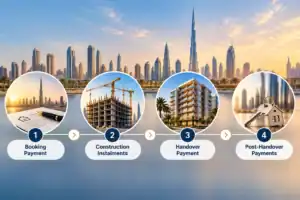
A payment plan is the schedule in your sales contract. It tells you how much to pay and when. Most Dubai property payment plans follow the same five steps.
First, you pay the booking amount and sign the sales and purchase agreement. Second, you register the sale with the DLD on a system called Oqood, an early ownership record for a home still under construction. The registration must happen within 90 days of signing, and the buyer receives a provisional registration certificate by email.
Third, you pay instalments while the building goes up. Some are tied to building stages, and others fall on fixed dates. Fourth, when the building is finished, you make the handover payment, and the developer gives you the keys. Fifth, once your unit is fully paid, it moves from the early register to the main property register, and you receive your title deed.
Registration is not paperwork. Under Law No. 13 of 2008, an off-plan sale that is not registered is void, so ask to see your Oqood certificate before you make the next payment. If you are still choosing where to buy, our guide to Dubai property investment is a good place to start. (Source: Dubai Land Department)
Where Does Your Money Go? Escrow Accounts Explained
An escrow account is a separate bank account that holds buyers’ money while the building is made. Under Law No. 8 of 2007, every developer selling off-plan in Dubai must open one for each project, at a bank approved by the DLD. Your payments go into that account. The money can only be spent on building that project and settling its financing, and the Real Estate Regulatory Agency (RERA) audits the accounts. Before selling, developers must also give an unconditional bank guarantee worth 20% of the project value, or finish 20% of construction.
For you, the rule is simple. Pay only into the escrow account named in your contract. If anyone asks you to send money somewhere else, stop and ask why.
You can check a project yourself in the Dubai REST app. It shows the project’s escrow account number, how far construction has progressed, site photos, and the payments due on your units. Look before your first payment and again every few months. Source: Dubai Land Department, Know Your Rights guide.
Which Off-Plan Payment Plans Are Common in Dubai?
Developers choose their own plans, so no two projects are exactly alike. Most fall into a few shapes. In a stage-linked plan, instalments follow construction milestones. In a date-linked plan, you pay on fixed dates regardless of the stage. Many plans mix the two.
The other question is how the price is split between construction and handover. A 60/40 plan means 60% before handover and 40% at handover. An 80/20 plan means 80% and 20%. Some developers also offer post-handover plans, where part of the price is paid after you get the keys. Watch the numbers, because some developers quote the handover share first. A “40/60” plan can mean 40% during construction and 60% at handover. Check which number is which in your contract.
Here is our AED 1.5 million example on three plans.
| Plan | During construction | At handover | After handover |
| 60/40 | AED 900,000 | AED 600,000 | None |
| 80/20 | AED 1,200,000 | AED 300,000 | None |
| 40/20/40 | AED 600,000 | AED 300,000 | AED 600,000 (about AED 16,667 a month for 36 months) |
Example only. The booking payment is part of the construction share, and government fees are extra. Real plans are set by each developer.
What matters is cash flow. A plan with a small handover payment is gentle at the end but asks for more during construction. A post-handover plan spreads the cost out, yet a longer plan changes when you pay, not necessarily what you pay. Compare the total price as well as the instalments.
When Do You Pay? A 60/40 Timeline for the AED 1.5M Example
Here is how the money moves on the 60/40 plan, assuming a 36-month build, stage-linked instalments and the full 4% DLD fee on the buyer.
| When | What you pay | Amount | Running total |
| Day 0 (booking) | 10% booking + full 4% DLD fee (plus any Oqood admin fee) | AED 210,000 | AED 210,000 |
| Within 90 days | Sale registered on Oqood; certificate emailed to you | No extra payment | AED 210,000 |
| Months 3 to 12 | 20% over early construction stages | AED 300,000 | AED 510,000 |
| Months 12 to 24 | 20% over middle construction stages | AED 300,000 | AED 810,000 |
| Around month 30 | 10% at the final construction stage | AED 150,000 | AED 960,000 |
| Handover (around month 36) | 40% handover payment + about AED 520 in DLD title deed and map fees | AED 600,520 | AED 1,560,520 |
Example only. Stages, dates, and admin fees vary by developer, and service charges start after handover. If handover slips, the 40% is still due at handover, so keep that money available.
Every project has its own terms, whether it is in Dubai South, Dubai Islands, or Jumeirah Village Circle. You can ask our team for current off-plan payment plans on specific projects before you commit to anything.
What Do You Pay on Top of the Plan? DLD Fee and Oqood
The plan covers the price of the home. Government fees come on top. The main one is the DLD registration fee of 4% of the sale price. The DLD’s default is an equal split, 2% for the buyer and 2% for the seller, but on off-plan sales most developer contracts put the full 4% on the buyer. In our example, that is AED 60,000 rather than AED 30,000, so read that clause before you sign.
Two small charges of AED 10 each, for knowledge and innovation, are added to the registration. Registering the sale on Oqood also carries an AED 1,000 developer fee, and many developers pass this, or a higher Oqood admin fee, on to the buyer, so check the fee schedule in your contract. At handover, budget about AED 520 in fixed DLD charges: AED 250 for the title deed, AED 250 for the unit map, and AED 20 in knowledge and innovation fees, plus any handover or NOC fees your developer sets.
Some launches come with a DLD fee waiver. That means the developer pays the fee for you. It does not disappear, so ask whether the waiver covers the full 4% or only part of it. For service charges, utility connections and agent fees, see our guide to the cost of buying property in Dubai. (Source:Dubai Land Department)
Can You Get a Mortgage on an Off-Plan Property in Dubai?

Yes, but only for part of the price. The UAE Central Bank sets a maximum loan of 50% of the property’s value for property bought off-plan, whoever the buyer is. So you need to fund at least half yourself. Banks can lend less than the cap.
Some banks now build products around this. Dubai Islamic Bank has launched a Shariah-compliant off-plan finance product for up to 50% of the value. The bank pays the developer as construction reaches its stages, and during the build you pay only the profit part. The full monthly instalment starts at handover, or within 24 months of taking the finance, whichever comes first. ADCB, working with developer Ellington Properties, offers pre-approval of up to 50% on off-plan homes. The pre-approval lasts 12 months and can be renewed each year until handover. (Source: Khaleej Times)
The risk to watch is the handover payment. If you plan to pay it with a loan, ask a bank early what it will lend, because lending rules and the bank’s valuation can change by the time the building is done. Our UAE real estate investment guide helps you plan the numbers before you commit.
Can You Refuse a Payment If Construction Is Behind?
Sometimes, yes, and not many buyers know it. Escrow money is released to the builder only after the escrow trustee’s engineer confirms that a stage is done. The DLD’s own FAQ lets you use the same logic before you pay. Before you pay an instalment the developer has asked for, you can request a letter from a DLD-approved project consultant that confirms the completion percentage. Without that confirmation, the DLD says payment is not required unless the agreed stage has really been reached.
So when a payment request arrives, check three things. Has the stage in your contract been reached? What does the project status service show? Does the escrow account on the invoice match the one in your contract? The DLD’s project status page lists the developer, the completion date, and the escrow bank.
Do not hold back a payment on a guess. Your contract’s wording still matters, so get advice before you withhold anything. (Source: Dubai Land Department project status)
What Happens If You Miss an Off-Plan Payment?
A missed instalment does not let the developer keep everything straight away. In Dubai, the developer must first tell the DLD about the default. The DLD then sends you a formal notice giving you 30 days to pay or agree a settlement. Any settlement is written into a contract addendum that both sides sign.
If the 30 days pass, the DLD issues a certificate that records how much of the unit is built. That percentage decides what the developer can do next.
| How much is built | What the developer can do |
| Under 60% | End the contract and keep up to 25% of the unit’s value |
| 60% to 80% | End the contract and keep up to 40% of the unit’s value |
| Over 80% | Keep the contract and chase the balance, ask the DLD to auction the unit, or end the contract and keep up to 40% |
| Work not started (not the developer’s fault) | End the contract and keep up to 30% of the amounts you paid |
(Source: Khaleej Times) Citing Law No. 13 of 2008 as amended. These rules apply to Dubai only.
Whatever the developer does not keep must be returned to you within one year of ending the contract, or within 60 days of reselling the unit, whichever comes first.
If you can see trouble coming, talk to the developer before the due date. The 30-day notice is your window to settle, so use it early and keep everything in writing.
What If the Developer Is Late? Delays, Refunds and Defects
Developers can run late, and the rules on what you can do are narrower than most buyers expect. Here is what the law covers and what depends on your contract.
Delays and Refunds
RERA can cancel a project that is badly delayed or stalled. If that happens, the DLD asks the developer to refund buyers within 60 days of the cancellation decision, though that period can be extended.
If the project is not cancelled, it is harder. The DLD says it cannot end your contract at your request, so getting your money back would mean going to court. Compensation for a late handover depends mostly on your contract, so read the delay clause before you sign, not after.
Handover Day: Size, Defects and Service Charges
If your unit is smaller than the contract says by more than 5% of its net area, the developer must compensate you. After completion, the developer must repair structural defects for 10 years and minor defects for one year. To cover this, 5% of the money buyers paid stays in escrow for a year. Walk through the unit and list every fault in writing before you accept it. Source: Dubai Land Department
Budget for service charges too. They are charged per square foot, and the DLD’s Service Charge Index shows the approved rate for your community. Gulf News reports rates from about AED 3 to AED 30 or more per square foot. Finally, title deeds are issued once a unit is fully paid, so if your plan runs past handover, ask in writing when you will get yours. (Source: Gulf News)
Can You Sell an Off-Plan Property Before Handover?
Yes, but not on your own terms. The DLD says an off-plan contract can be resold before the title deed is issued only after the developer gives a No Objection Certificate. Developers often set a minimum amount you must have paid first, and your contract gives the exact figure, so check it before you book.
Do not count on a quick exit. Off-plan sales make up roughly 70% of Dubai home sales, yet resales were only about 9% of off-plan deals in 2025. In a few investor-heavy areas, some resales have closed at or below the launch price. Plan to hold the unit and treat a resale as a bonus. (Source: Khaleej Times)
If residency is part of your plan, read our Golden Visa property rules before you pick a unit.
How to Choose a Dubai Payment Plan: Six Checks Before You Sign
Run every plan through these six checks before you sign.
- Worst-month cash flow. Add up every instalment. Could you still pay them if your income dipped or handover slipped by a year?
- Total cost. Count the full price, not the headline one. Add the DLD fee, handover costs, and service charges.
- Handover date and delay clause. Read them together.
- Developer and project. Check the developer’s record, and that the project has an escrow account and Oqood registration.
- Who pays the 4% DLD fee? Find out before you commit.
- Exit and finance. Know what the resale clause says, and whether a bank will lend at handover. If you are buying property in Dubai as a foreigner, ask the bank early, because banks set their own rules for non-resident loans.
At Blueline Properties, a Dubai-based, investment-focused real estate advisory, we help investors compare plans against these checks. We work with licensed UAE brokerage partners and support you from the first consultation to the transaction. Our featured projects and investment areas, including Dubai South, Dubai Islands and Jumeirah Village Circle, are a good place to start.
Plan Your Dubai Off-Plan Purchase With Blueline Properties
A payment plan only works if it fits your cash flow and the project holds up. Before you pay a booking deposit, let us check both.
Tell us your budget and goals. We will compare plans line by line, show you the real total cost, including the DLD fee and service charges, and flag clauses to question before you sign. It is a conversation, not a commitment.
Speak with an advisor or message us on WhatsApp at +971 52 8432958.
This guide is general information, not legal or financial advice. Rules and fees can change, so check your contract and confirm details with the DLD or a qualified adviser.
FAQs
1. What does a 60/40 payment plan mean?
It usually means you pay 60% of the price before handover and 40% at handover. Some developers write the numbers the other way round, so check your contract. On an AED 1.5 million home, that is AED 900,000, then AED 600,000.
2. How much do you pay upfront on an off-plan property?
The developer sets the booking amount in your contract. In our example, a 10% booking is AED 150,000. Add the 4% DLD fee, which most developers pass to the buyer: AED 60,000, or AED 30,000 if your contract splits it 2/2. So budget about AED 210,000 on day one, plus any Oqood admin fee.
3. Is the DLD fee included in the payment plan?
Usually not. It is a government fee paid on top of the price. The DLD’s default is a 2/2 split between buyer and seller, but most off-plan contracts put the full 4% on the buyer.
4. Are my off-plan payments safe in Dubai?
Dubai law requires payments to go into a project escrow account, and the money is released as stages are built and checked. That only protects you if you pay into the right account, so match every invoice to your contract.
5. Can non-residents use off-plan payment plans?
Yes. International buyers can buy off-plan in Dubai’s freehold areas and use a developer’s payment plan. Banks set their own rules for non-resident loans, so ask early if you plan to borrow.
6. Can you get a mortgage on an off-plan property?
Yes, but only up to 50% of the property’s value, because of the Central Bank cap. You fund the rest yourself. Banks such as Dubai Islamic Bank and ADCB offer off-plan products.
7. What happens if you cannot pay an instalment?
The developer must report it to the DLD, which gives you 30 days to pay or agree to a settlement. After that, the developer can end the contract and keep up to 25% or 40% of the unit’s value, depending on how much is built.
8. Can you cancel an off-plan purchase in Dubai?
Not freely. The DLD says it cannot cancel your contract at your request unless the project itself is cancelled. Your options are to resell with the developer’s No Objection Certificate, agree to an exit with the developer, or go to court. Get legal advice first.